Total Pageviews

Showing posts with label eclipse. Show all posts

Monday, 11 July 2022

theia

 Eclipse Theia is a cloud & desktop IDE framework implemented in TypeScript. 

  theia-ide.org 

Cloud & Desktop IDE Framework

Gitpod Ready-to-Code PRs Welcome Discourse status Build Status Publish VS Code Built-in Extensions Open questions Open bugs

Eclipse Theia is an extensible framework to develop full-fledged multi-language Cloud & Desktop IDE-like products with state-of-the-art web technologies.

Theia 1.0 has been released. Read the announcement.
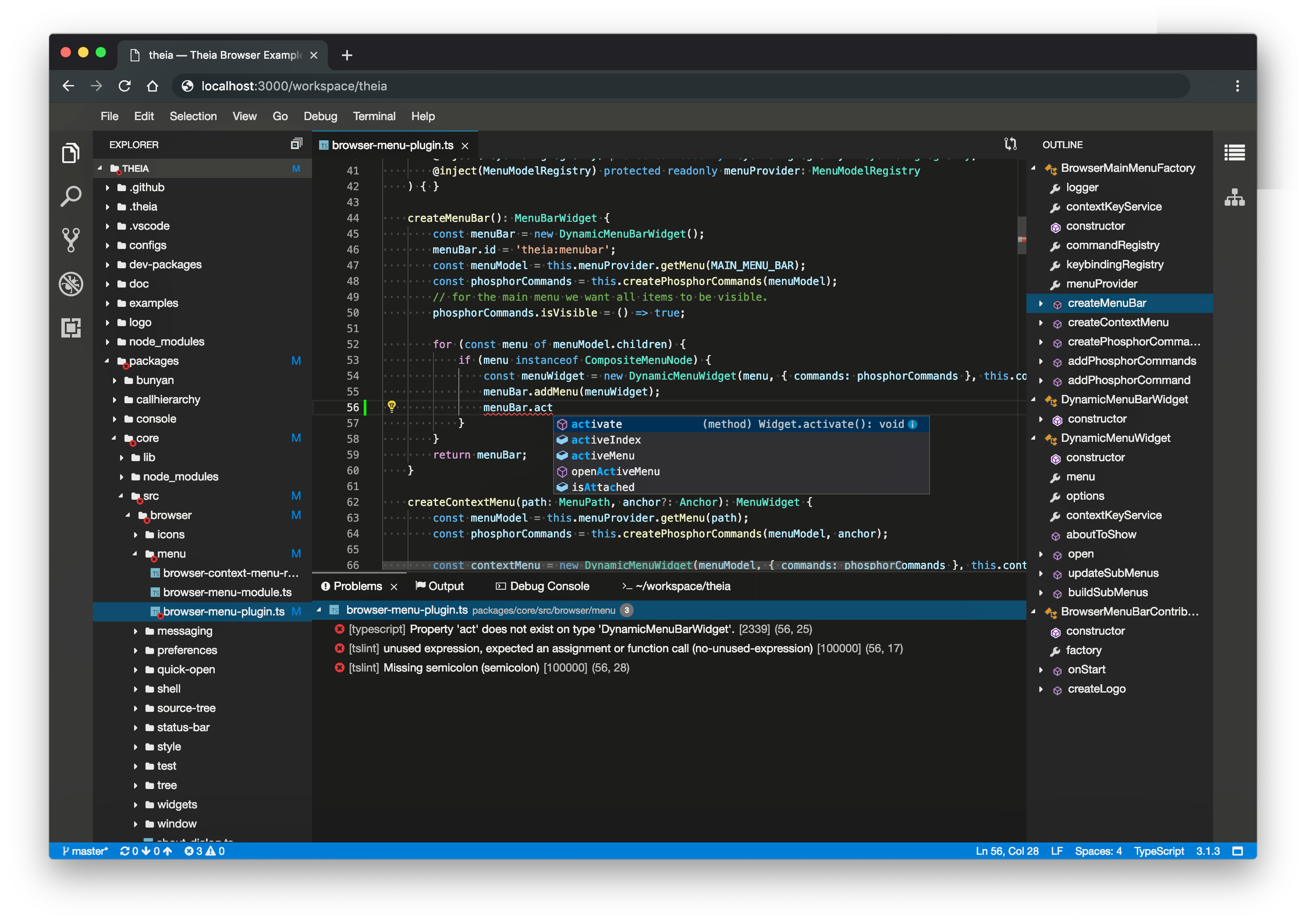
Theia

Website

Visit the Theia website for more documentation.

Scope

  • Support building browser-based and desktop IDEs
  • Provide a highly flexible architecture for adopters
  • Support VS Code Extension protocol
  • Develop under vendor-neutral open-source governance

Roadmap

See our roadmap for an overview about the current project goals and the upcoming releases.

Getting Started

Here you can find guides and examples for common scenarios:

Contributing

Read below to learn how to take part in improving Theia:

Feedback

Read below how to engage with Theia community:

  • Join the discussion on Discourse.
  • Ask a question, request a new feature and file a bug with GitHub issues.
  • Star the repository to show your support.
  • Follow Theia on Twitter.

Documentation


Monday, 16 June 2014

Model Analysis Framework


Description

The Model Analysis Framework (MAF) project provides a powerful analysis tool for (meta) models built upon the Eclipse Modeling Framework (EMF). It allows to perform data-flow analysis (DFA) on meta models which can be defined using Java directives or an extended OCL syntax. The framework will then instantiate and evaluate the custom analysis directives for arbitrary instances of the meta model.
Use cases include but are not limited to the computation of the cycle time of business processes, the generation of test cases, the advanced validation of static semantics or the analysis of model metrics.

Currently supported features

  • built upon the Eclipse platform (Helios)
  • GUI independent framework core designed to run as background service
  • can be easily extended using own input/output adapters
  • write DFA equations using Java or OCL
  • full support for EMF (meta) models
  • internal model repositories for meta models / models / data flow definitions

Example Use Cases

  • Several example use cases have been implemented on top of business processes which can be created using the Eclipse Java Workflow Tooling Editor
  • Use cases include calculation of minimal/maximal predecessors and successor sets, identification of Strongly Connected Components (SCC), identification of Single-Entry-Single-Exit regions, validation of structural correctness and completion of quasi-structured components
Single-Entry-Single-Exit (SESE) component detection [1] and validation [2] for control-flow graphs has been implemented using flow-analysis (project MAF-DFA-JWT-TOKEN). The image below shows the SESE components of a JWT process model (one of which is highlighted green) and the results of the validation for structural correctness (click to enlarge).

[1] Token analysis of graph-oriented process models (Götz, Roser, Lautenbacher, EDOCW 2009)
[2] Faster and more focused control-flow analysis for business process models through sese decomposition (Vanhatalo, Völzer, Leymann, ICSOC 2007)

Roadmap

  • The second stable version (1.1.0) has been released which includes editors for creating and configuring model analyses along with several example projects
  • The source code can be obtained from the SVN (the plugins are described in the wiki)
  • Current status is well-advanced, version 1.1 can be installed from the Eclipse Update Site (see below)

Installation

To install the Model Analysis Framework

About the project

Model Analysis Framework is a research project located at the Programming Distributes Systems Lab at the University of Augsburg, Germany (project site).
The concept of using a data-flow based approach for model analysis is described in the paper Data-flow Based Model Analysis

from https://code.google.com/a/eclipselabs.org/p/model-analysis-framework/ 

Wednesday, 18 July 2012

如何汉化Aptana Studio 3


下面的汉化方法。
Aptana Studio 3(下面简称Aptana 3)的汉化方法—KingDZ原创http://www.cnblogs.com/hihell
哈哈
开始汉化吧~~~
1、找到这个网站 http://aptana.com/support
2、单击下面的链接
3、在下面的语言中找到图示的选项
4、然后在右边找到
5、接下来找到这个页面中的链接地址
哦了,到这,就得到了 俺想要的地址了
6、得到地址
下面就是操作过程了点击 “Help” > “Install New Software”;
我的已经中文化了,所以下面的截图是中文版的
然后再出现的窗口上面选择 复制上上面的地址,选择 add
正文会出现语言包列表,选择 中文简体【图上所示】 一路“next”,直到“finish”;
最终,你的
Aptana 3 就是简体中文啦
哈哈,相信大家从上面我的截图也已经看到 ,简体中文版的 效果了。
--------------------------------------------------------------------------
Web开发环境-Aptana Studio

Aptana Studio是一款集成式Web开发环境, 是基于Eclipse的IDE。可以支持HTML, CSS, XML, AJAX以及JavaScript工具箱, 包括JavaScript编辑和调试。此外,AptanaStudio还包括RubyonRails, Python以及PHP的支持, 并集成了 Git 插件。aptana studio可以作为独立的程序运行,也可作为Eclipse插件使用。

特色:

①智能代码完成:不仅涵盖 JavaScript 语法,还包括HTML 和 CSS 。

②浏览器兼容性提示:在 JavaScript 的每一个属性或方法提示之后,均会跟随该属性或方法适用于的浏览器类型。

③代码错误提示

④文档结构树:提供了类似 DOM 查看器的工具来帮助分析页面文档的层次结构。

[repo owner=”aptana” name=”studio3″]




